
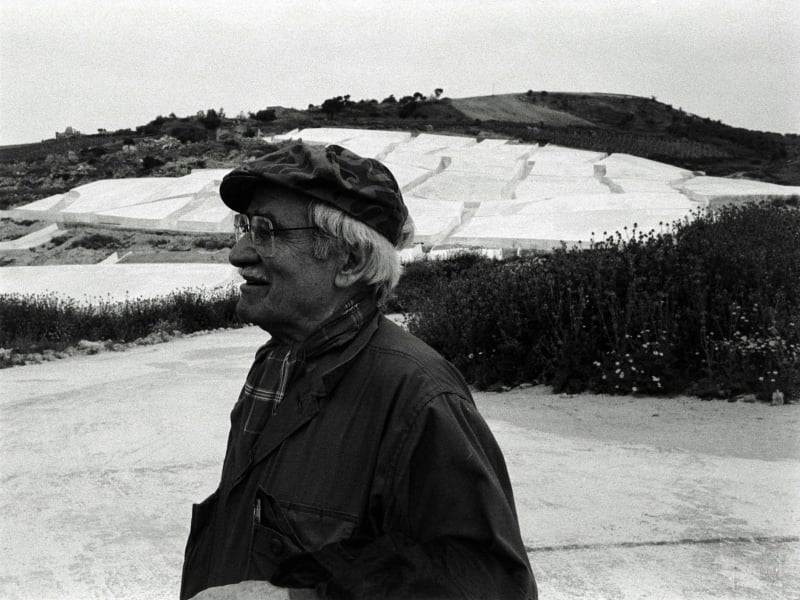
Alberto Burri is an Italian painter and conceptual artist known for his adventurous use of new materials. Born on 12 March 1915 in Città di Castello, he graduated in Medicine in 1940, later enlisting as a medical officer.
During the Second World War, he was imprisoned in the prison camp in Hereford, Texas, along with 3,000 other Italian officers. There, he took up painting in 1944, mainly due to the death of his younger brother Vittorio, who died on the Russian front.
In Rome, the first series of informal works with different and mixed techniques: the Tars, the Moulds, the Humps
Returning to Italy in 1946, he gave up medicine to concentrate solely on painting, establishing himself in Rome.
In 1947, he had his first solo exhibition at the Galleria La Margherita, followed by exhibitions at the Marlborough Gallery in New York and the Gallery de France in Paris.
Burri’s artistic production exploded in the same year into abstract forms and unorthodox materials, influenced by Jean Dubuffet and Jean Mirò.
Between 1948 and 1950, he created the Tars, works composed of tar, sand, zinc, pumice and PVC glue, using tar not only as a material but as an actual material colour.
In the Moulds series, he literally makes the materials used react with each other, creating real moulds, in other works called the Humps of the same period, Burri focuses on the three-dimensionality of the painting by incorporating tree branches on the back of the canvas.
In 1951, he joined the ‘Gruppo Origine’ with Giuseppe Capogrossi, Ettore Colla and Mario Balocco, a movement that was dissolved in the same year of its foundation, an event that testifies to Alberto Burri’s attitude towards increasingly independent artistic research.
Alberto Burri’s Sacks: colour disappears, art becomes conceptual
From 1952, he created his most revolutionary works, the famous Sacks (made of jute fabric). The poor material tells its own life story through burns and seams, becoming a symbol of universal pain. Colour almost disappears, it is all material surfaces treated by steams, tears, cuts, layers of colour and different shapes, but always controlled in a harmonious balance.
These are works that caused a great scandal. Two Sacks, The Rip, and Patch were rejected in ’52 by the Venice Biennale. When the Galleria Nazionale d’Arte Moderna in Rome bought Large Sack, it provoked a parliamentary interpellation calling for the work’s removal in 1959.
In 1953 the turning point overseas: Burri in the United States
After Rome, his solo exhibitions were held in many American museums: the one at the Solomon R. Guggenheim Museum in New York, in particular, received excellent reviews, thanks to director James Johnson Sweeney‘s particular esteem for Burri’s work.
So much so that in 1955, Sweeney himself wrote the first monograph on Burri.
Burri’s style is close to the informal art movement, a trend that arose and spread in Europe, typical of the post-war cultural climate. Pierre Restany considered Burri to be a ‘special case’ in the history of minimalism, having been ‘the monumental outsider and brilliant precursor at the same time’.
Between the fifties and sixties, Burri manifested his distrust of rationality, considering action as the only means of expression. The painting tends towards a continuous tension towards an uncontrolled and instinctive self-expression, going beyond the usual figurative categories. It therefore rejects perspective, form, contours and academic canons. Even the support of the work is transformed into matter that can be modified by the artist.
After 1957, Burri produced the works Woods, Combustions and Metals, introducing fire as a subject for experimentation.
Cretti and Cellotex
In 1963, he began spending winters in Los Angeles.Trips to the Death Valley National Park gave rise to the idea of the Cretti. The natural cracks in the desert become inspirations for works he creates himself through chemical processes and the sudden heating of the material.
The Cretti become sculptures of vast dimensions such as the Cretto in Gibellina, a white concrete casting that stretches with its enormous cracks over an area of a previously destroyed village, covering 914,930 square feet, a work only completed in 2015 for the centenary of Burri’s birth. These works exploit the principles of very large-scale sculpture (almost land art) by working on space and architecture.
From the late 1970s onwards, he concentrated on Cellotex (a mixture called Celotex to which Burri added an L, an industrial mixture of waste and adhesives from insulation panels).
Burri and theatre
A great passion of his was theatre, for which he created numerous stage sets. For Spirituals, in 1963, at La Scala in Milan. In 1969, for the stage adaptation of Ignazio Silone and Tristan and Isolde, in 1975 at the Regio di Torino.
In 1973, he designed sets and costumes for Toru Takemitsu’s November Steps.
The last years, the last exhibitions
In 1981, Città di Castello opened a permanent collection of his works in Palazzo Albizzini. Three years later, a large retrospective with over 160 works was held at Palazzo Citterio in Milan.
Also in the 1980s, the artist exhibited his creations in New York, Paris, Nice and Rome.
In 1989, the Palazzo Albizzini Foundation purchased the Ex Seccatoi del Tabacco, a complex of industrial warehouses, in Città di Castello, which were transformed into a museum entirely dedicated to the artist, painted black on the outside by Burri’s will.
In 1991, important retrospectives were held at Palazzo Pepoli Campogrande, organised by the Pinacoteca Nazionale di Bologna, an exhibition that continued in Locarno and, at the same time, 20 unpublished Cellotex were exhibited at the Castello di Rivoli.
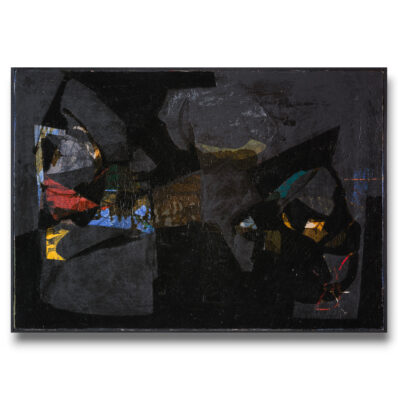
In 1993, a new cycle of works, entitled The Black and the Gold was exhibited at the Ex Seccatoi del Tabacco.
In 1994, Burri’s donation to the Uffizi in Florence included a Black and White painting from 1969 and three series of graphic works from 1993-94.
He died in Nice on 13 February 1995.
Art of Alberto Burri for sale
Biography of Alberto Burri
Information request
Artwork:
Artist: