

Georges Mathieu was born on 27 January 1921 in Boulogne-sur-Mer.
He graduated in English after studying law and philosophy in Lille and managed to get a job in Paris in the following years (from 1947 onwards) as public relations manager for U.S. Lines, an American shipping company.
Mathieu, the free informal art
In 1942 he began his aesthetic reflection, ‘Painting does not need to represent’. Hence his first non-figurative piece, Inception.
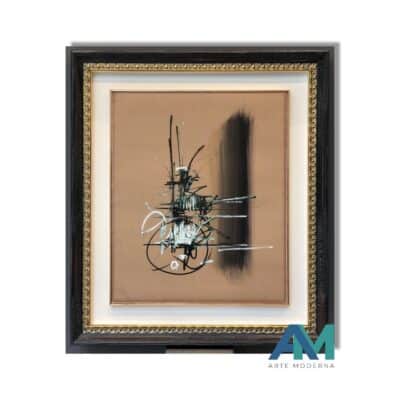
In 1944, he began to follow a free, gestural abstraction and to paint non-figurative pictures. He is considered one of the key exponents of European lyrical abstraction, a current of informality.
From 1947 onwards, his technique of applying colour directly from the tube began to make its mark. During this period, he met Salvador Dali.
Mathieu and lyrical abstraction
He participates in and organises numerous exhibitions in favour of Abstraction Lyrique, of which he is a fervent supporter. A lyrical, gestural or ‘tachists’ abstraction, which renounced predominant rules and traditions to concentrate on purely pictorial phenomena.
The spirit of the moment spurred artists to develop a new form of gestural painting, allowing painting to be experienced in a different way, with total involvement. Mathieu first imposed gestural painting in the School of Paris, working together with Hartung, Soulages, Wols, Fautrier and other artists of the New York School, at a time when there was no exchange between the two capitals.
His employment with the U.S. Lines allowed him to keep abreast of the avant-garde on the New York scene, immediately understanding the affinities between abstract expressionism and lyrical abstraction, and putting him in contact with American galleries.
Mathieu’s first exhibitions and the conception of lyrical abstraction manifestos
In 1946 he exhibited for the first time at the sixth Salon des moins de 30 ans, in the Galerie des Beaux-Arts in Paris, and held his first solo exhibition in 1950 at the Galerie René Drouin in Paris.
A year later, in 1947, he organised Ve’he’mences confronte’es together with the art critic Michel Tapié. In this exhibition, emphasis was placed on trends in non-figurative painting, through the experiences of American painting from De Kooning to Pollock, Capogrossi, Bryen, Riopelle, Hartung and Wols.
In the same year, he published a number of manifestos (at least 4) to conceive and define his concept of lyrical abstraction, the concepts revolve around the primacy of speed in execution, no pre-existing reference, no premeditation and cognitive process, ecstatic state of mind, favoured by isolation.
“I didn’t paint fast for lack of time or to break records, but simply because I didn’t need more time to do what I had to do and vice versa a longer time would have slowed down the gesture, introducing doubts, would have affected the purity of the strokes, the cruelty of the forms, the unity of the work of art.”
World travel and fame
He started painting his large canvases as early as 1952 (“I love to paint oversized paintings, because the risk is greater here”). Some of his techniques anticipated Pollock’s Action Painting.
From 1957 to 1959 he travelled and worked in Japan, Brazil, the Middle East and Argentina.
In 1965 he exhibited about a hundred paintings at the Galerie Charpentier, followed by a major retrospective at the Grand Palais in 1978 where he showed the last 15 years of his production.
Mathieu’s commitment to culture and education
Mathieu is not only a painter but applies his art and influence in all the culture at his disposal – He supports the beauty of cities, the use of design in everyday objects, the culture organised by the mass media by making contributions in handicrafts (he created his series of porcelain plates), in architecture (in 1964 he produced architectural plans for the city of Castellas), producing tapestries, designing stamps, coins, producing advertising campaigns (for Air France and Deutz).
He defended the introduction of compulsory art courses in French schools, the theoretical study and practical exercise of the arts, not only painting, but also singing, music and sculpture.
He died on 10 June 2012 in France, in Boulogne-Billancourt and is buried in Paris, in Montmartre Cemetery.
Art of Georges Mathieu for sale
Biography of Georges Mathieu
Information request
Artwork:
Artist: