
© 2025 Fondation Vasarely
© 2025 Fondation Vasarely

KET-KAB
Technique
Acrylic on canvas
Dimensions
inch. 74,3 x 38,7
Year
1987
Origin
Private collection, acquired directly from the artist;
Anon. sale; Oger-Blanchet, Paris, 8 October 2013, lot 444;
Private Collectione, New York;
A.M. Arte Moderna, Brescia.
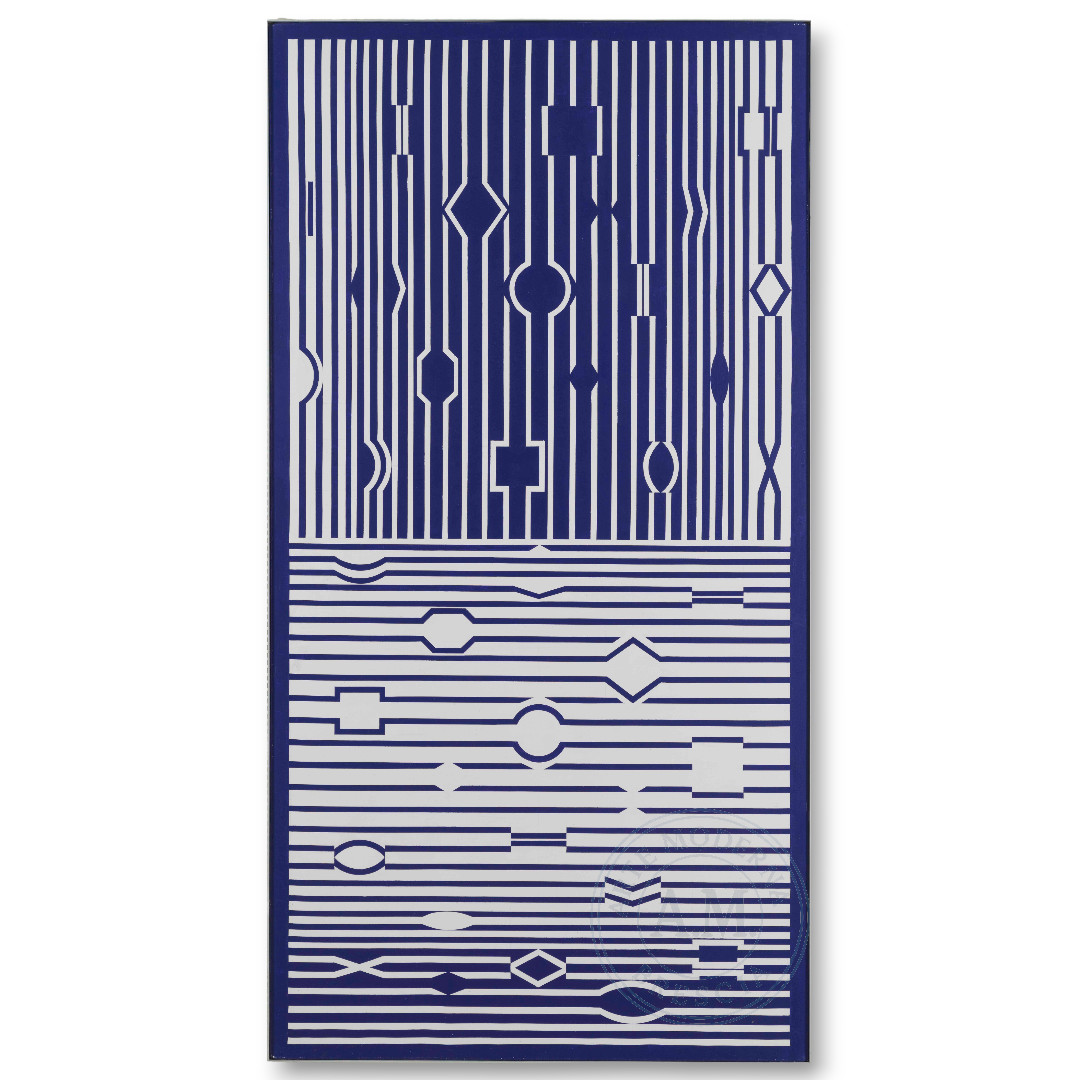
The work presented here, created in 1987 but derived from a project of 1960, testifies to the coherence and continuity of his research, the acrylic on canvas, in a large vertical format (inch. 74 ¼ x 38 ¾), is structured into two distinct yet complementary fields: in the upper half white vertical lines dominate against an intense blue background; in the lower part the lines are arranged horizontally, maintaining the same graphic tension, this orthogonal opposition generates a dynamic balance that actively engages the viewer’s gaze.
The central element of the work is the modulation of the line: the white bands deform, interrupt and expand to accommodate pure geometric forms, circles, diamonds, rectangles, ovals that emerge as optical vibrations within a rigorous grid, the forms seem to pulsate, advance or recede, producing an illusion of movement and three-dimensionality despite the total bidimensionality of the pictorial surface.
This type of work fully belongs to the poetics of Op Art: the optical effect arises from the interaction between rhythm, chromatic contrast and geometric modulation, blue and white, chosen for their strong contrast, amplify the visual vibration and the artist does not paint objects, but constructs a visual experience based on unstable perception and spatial ambiguity, the viewer becomes an active part of the work: it is the eye that completes the process, interpreting and re-elaborating the tensions between figure and ground.
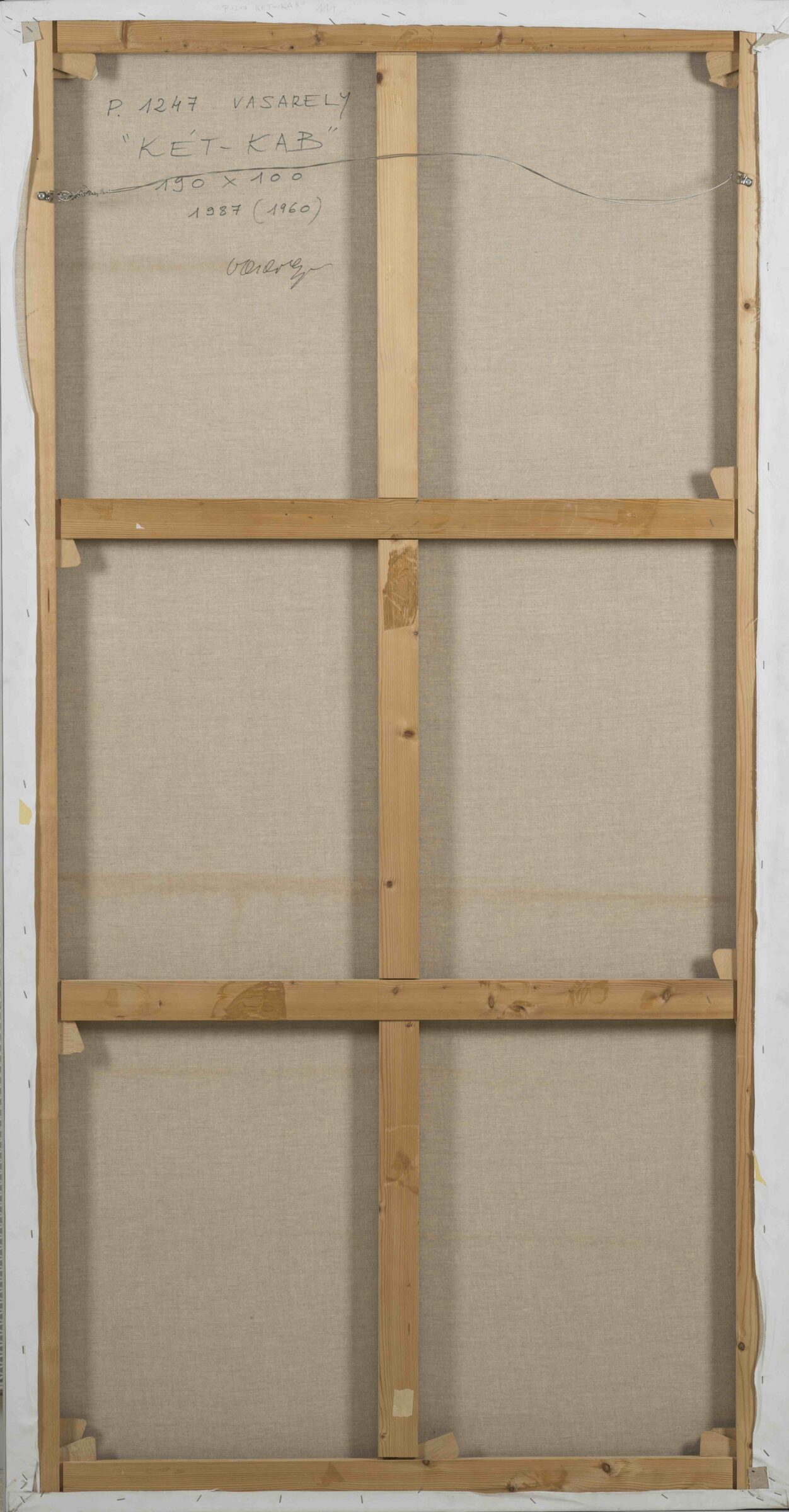
In this composition one can also perceive the systematic aspect of Vasarely’s work: the piece is not an isolated episode, but part of a modular, almost mathematical research, in which each variation arises from a basic scheme, art thus becomes a field of rational experimentation, where rule and freedom coexist; the double dating (1960/1987) precisely underscores this projectual continuity: the original idea is revisited and realized at a later moment, confirming the timeless validity of his language.
Ultimately, this canvas exemplarily represents Victor Vasarely’s vision: an international, scientific and universal art, capable of transforming geometry into sensory experience through the rigorous simplicity of lines and forms.
Information request
Artwork:
Artist: