
© The Paul and Suzanne Jenkins Foundation
© The Paul and Suzanne Jenkins Foundation
Phenomena Rhodian Finde
Technique
Oil on canvas
Dimensions
inch 28 x 22
Year
1962
Origin
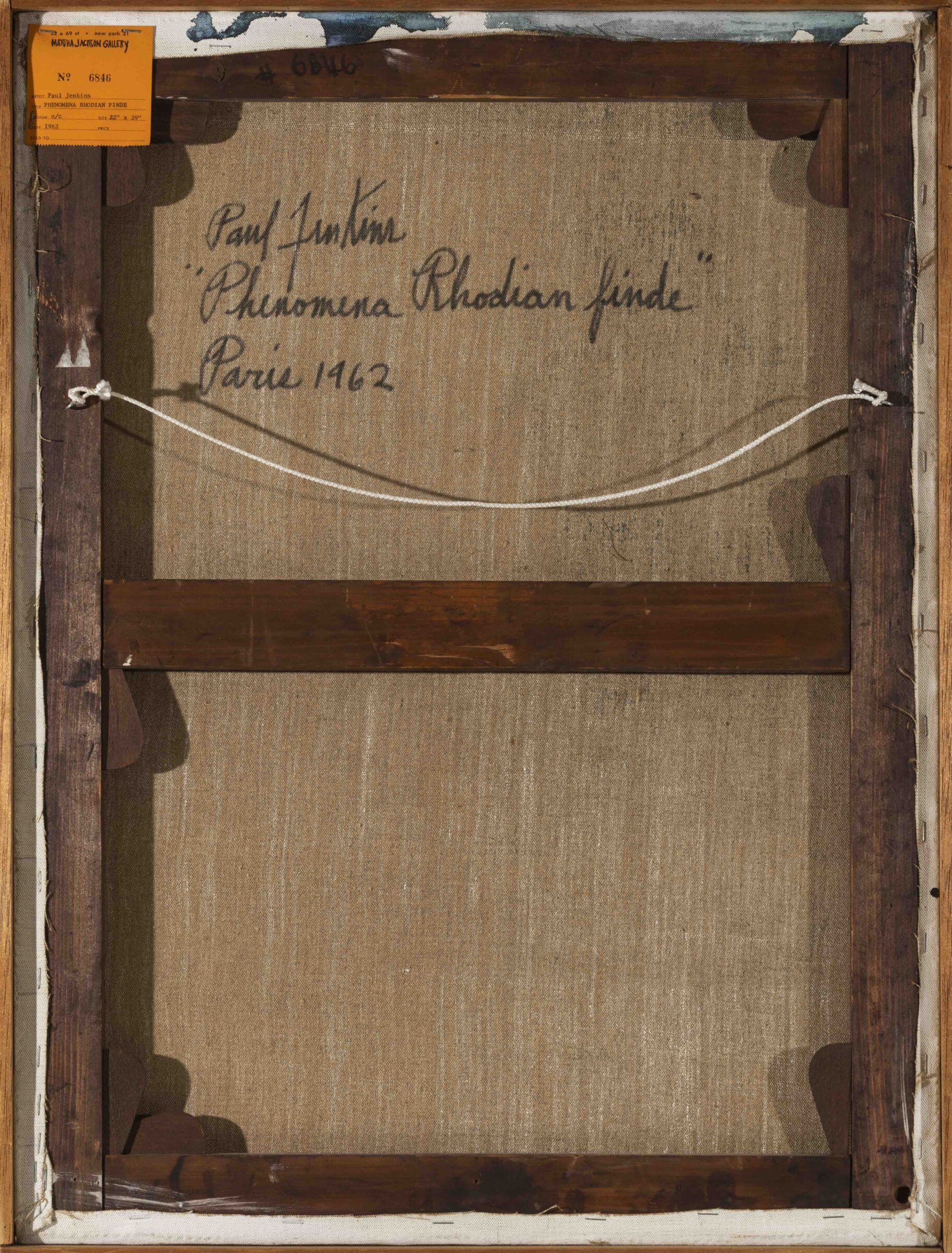
Marta Jackson Gallery, New York (US);
Private Collection, Barcellona (SP);
A.M. Arte Moderna, Brescia (IT).
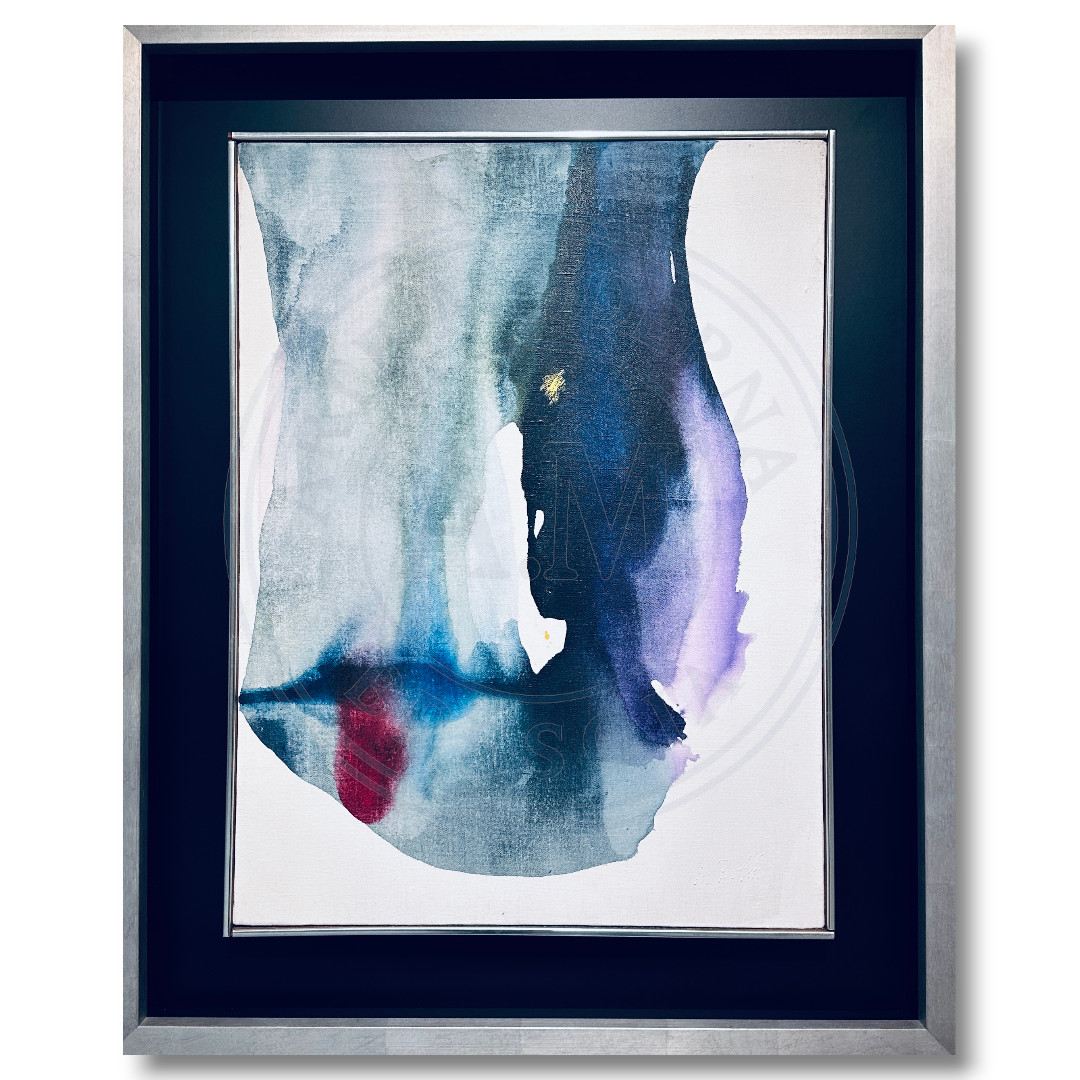
Created in 1962, Phenomena Rhodian Finde belongs to the “Phenomena” cycle, the central core of Paul Jenkins’s painterly research and one of the most intense moments of his artistic production, the 1960s in fact represent a phase of full maturity for the American artist, in which his investigation of color, light and matter achieves a synthesis of extraordinary coherence and expressive power.
Paul Jenkins is recognized as one of the most significant figures of Abstract Expressionism, while distinguishing himself through an autonomous position compared to the best-known protagonists of the movement, on the one hand he shares with artists such as Pollock and Rothko the idea of painting as a total experience and as a space of inner revelation, on the other he develops a personal language founded on a refined luministic research and on a rigorous control of chromatic flow.
In Phenomena Rhodian Finde, the pictorial surface is structured through large fluid fields that seem to slide vertically, generating a dynamic balance between transparency and depth, the green and blue tones, soft and atmospheric, interact with a more intense and darker mass of blue and violet, while a ruby red accent emerges in the lower section as a point of emotional condensation.
The title Phenomena Rhodian Finde reveals a profound connection between word and image, the term “Phenomena” recalls the idea of manifestation, of an event that appears and reveals itself to the gaze; “Rhodian” may evoke Mediterranean, luminous suggestions, connected to the intense light and the marine reflections of the island of Rhodes; “Finde” instead introduces an idea of discovery, of finding, the painting can therefore be interpreted as a chromatic revelation, a “finding” of light and matter that emerges from the depth of the canvas.
Information request
Artwork:
Artist: