Eyes of the Dove (Lucifer Life)

Eyes of the Dove (Lucifer Life)

Technique

Oil and enamel on canvas

Dimensions

inch. 30.3 x 40.2

Year

1959

Origin

- Arthur Tooth & Sons Ltd., London;
- Where purchased by Private Collection, thence by descent;
- Their sale; Christie's, London, 25 September 2014, lot 44;
- Private Collection, London;
- A.M. Arte Moderna, Brescia.

The series Eyes of the Dove (Occhi della Colomba) comprises approximately forty paintings created by Paul Jenkins between late 1957 and 1959, this series marks a crucial transitional moment in the artist’s career, immediately preceding the period in which he began to title nearly all of his works “Phenomena.”

The titles of this series often include specific subtitles that reflect the evocative nature of Jenkins’s work, these paintings represent the last body of works in which Jenkins predominantly used oil and enamel before shifting almost exclusively to acrylic paints in the 1960s, the works from this period are held in prestigious permanent collections, including the Museum of Modern Art, the Solomon R. Guggenheim Museum and the Whitney Museum of American Art in New York, as well as the Tate Gallery in London.

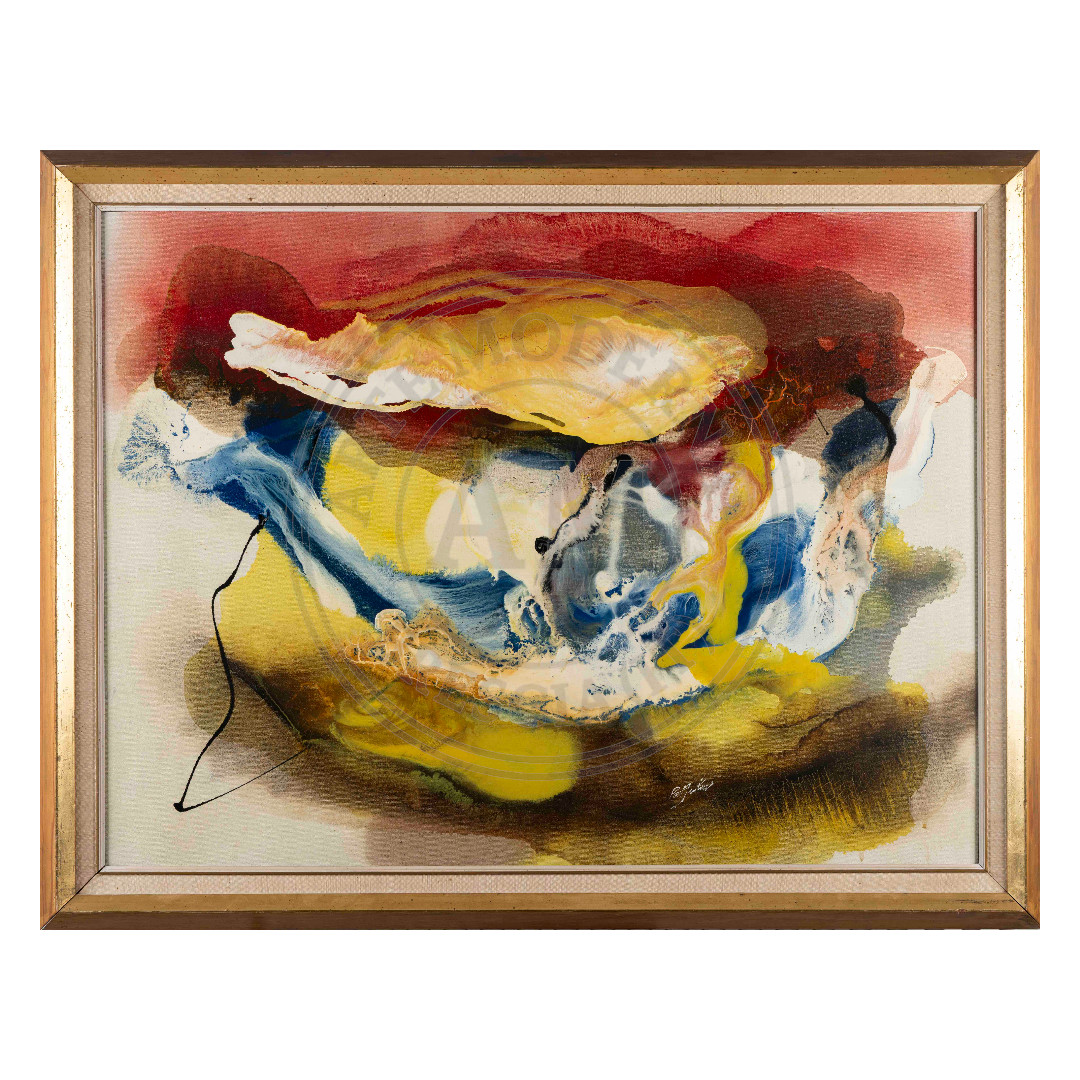
Majestic and vibrant, Eyes of the Dove: Lucifer Life is a painting belonging to one of the artist’s most celebrated series, entitled Eyes of the Dove, the work presents a symphonic ensemble of forms and colors: broad passages of blazing crimson red and solar yellow fill the canvas, interrupted by palimpsests of cerulean blue and soft cream white.

The Eyes of the Dove series was inspired by a story told by the art critic Harold Rosenberg, as the artist himself explained: “[he] told me about a Jewish rabbi who used to visit different synagogues, he would stop on the highest step and then descend one step saying, ‘The eyes of the dove,’ and then proceed into a kind of revelatory explanation, in words, of the religious experience; when he concluded, he would descend again and fall into another transport, he was greatly admired and followed, I thought to myself: yes, the eyes of the dove see everything, but never the same thing twice.” (P. Jenkins, quoted in A. Elsen, Paul Jenkins, New York 1975, p. 65).

Going beyond the two-dimensional plane of the canvas, Eyes of the Dove: Lucifer Life seems to expand beyond its own boundaries, for Jenkins, the canvas itself plays a fundamental role in his artistic practice, as he stated: “When I am asked whether I make a drawing before a painting, or whether I have an idea before beginning a picture, I point out that it is the very size of the canvas that dictates the direction to me, a blank canvas gives me a clue and in the Eyes of the Dove series I discovered that one painting may seem to contract and concentrate, to fold in upon itself, but another may appear as if it expands beyond its own limits, each achieved a difference of scale and my eye measured a reality that had nothing to do with the arbitrary scale of the yardstick.” (P. Jenkins, quoted in A. Elsen, Paul Jenkins, New York 1975, p. 65).

Eyes of the Dove: Lucifer Life was created in a manner similar to the contemporary method of Jackson Pollock: the canvas, unstretched, was placed horizontally on the floor, in contrast, however, Jenkins created poured forms, grooves and depressions structured with compositional intention.

The expression “Eyes of the Dove” evokes ideas of purity, light, and spiritual vision, while “Lucifer Life” can be interpreted as a reference to light and vital energy, since the name Lucifer derives from the Latin lux ferre, meaning “light-bearer.” The title therefore establishes a dialogue between two seemingly opposite yet complementary dimensions: purity and luminous strength.

A work of rare intensity and beauty, it not only represents a fundamental milestone in Jenkins’s career, but also constitutes a precious testament to an era in which painting sought to transcend the boundaries of the visible in order to become an inner experience.

A masterpiece that captivates collectors and connoisseurs alike for its evocative power and profound spirituality, capable of transforming any environment into a space of contemplation and light.