
© The Paul and Suzanne Jenkins Foundation

© The Paul and Suzanne Jenkins Foundation


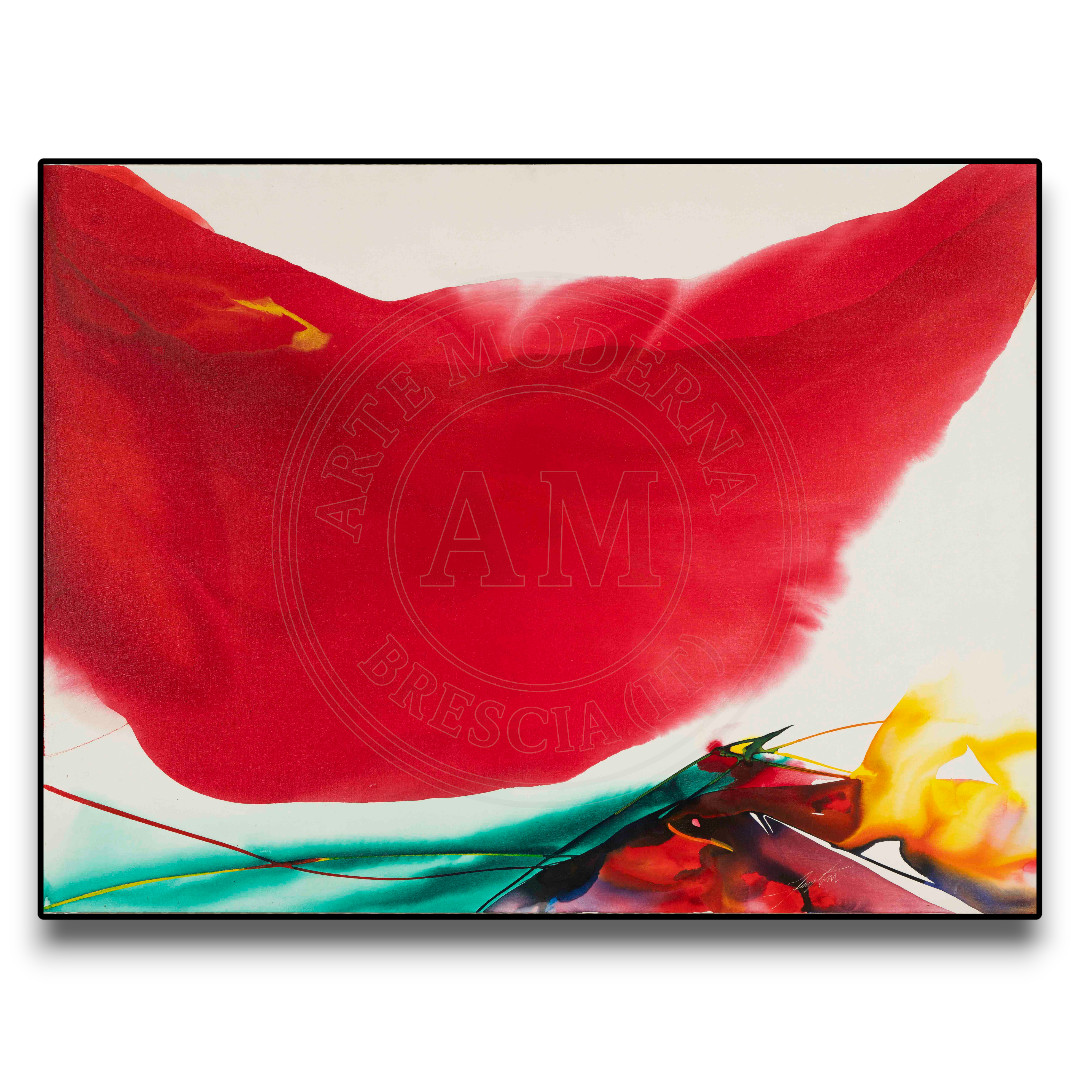
Phenomena Seen on Sight
Technique
Acrylic on canvas
Dimensions
inch. 51 x 77
Year
1967
Origin
- Martha Jackson Gallery, New York;
- Carone Gallery, Fort Lauderdale;
- Anon. sale; Sotheby's, New York, 11 November 1986, lot 209;
- Private Collection, New York;
- Christies New York, First Open, Post War and Contemporary Art, 28 September 2016, lot. 49;
- Private Collection, France;
- A.M. Arte Moderna, Brescia.
Paul Jenkins (1923–2012) occupies a prominent position in the international panorama of art of the second half of the twentieth century, as a protagonist of the season of American Abstract Expressionism and a connecting figure between the American and European scenes, his career developed within a global context, with exhibitions in the major museums and galleries of Europe, the United States and Japan, consolidating his reputation as one of the most refined interpreters of international lyrical abstraction.
Although associated with the so-called “second generation” of Abstract Expressionism, Jenkins developed an autonomous language, distinguishing himself through an innovative use of acrylic and a conception of painting as a fluid event, controlled yet open to chance, unlike the more gestural action painting, his practice is based on a subtle balance between intention and unpredictability: the color is poured, tilted, guided across the surface, creating transparent fields and luminous overlaps that evoke natural phenomena and inner states, his work played a fundamental role in renewing the concept of painting as a perceptual and meditative experience, contributing to the dialogue between American and European art at a crucial moment in the cultural history of the twentieth century.
PHENOMENA SEEN ON SIGHT, created in 1967, represents an emblematic example of his expressive maturity, the large-scale acrylic on canvas (121,9 × 162,5 cm) unfolds in a composition dominated by a broad and vibrant red field occupying much of the upper surface, the red, intense and enveloping, spreads like a cloud or a luminous wave, modulated by tonal variations and transparencies that suggest depth and movement, while in the lower and lateral areas bursts of bright yellow, counterpoints of green and turquoise, and darker traces emerge, structuring the space with dynamic lines and diagonal tensions.
The canvas is not simply painted, but becomes the site of a process: the color flows, expands and comes to rest according to inclinations calibrated by the artist. There is no traditional preparatory drawing; the composition arises from the interaction between gravity, gesture and chromatic sensitivity. The result is an image that appears simultaneously spontaneous and deeply orchestrated, in which light seems to emanate from within the pictorial matter.
Beginning in the 1960s, the artist systematically adopted the term “Phenomena” for his works, followed by a specification that alludes to an immediate perception, “Seen On Sight” may be translated as “seen at first sight” or “grasped in the immediacy of the gaze”, the title does not describe a recognizable subject, but suggests the idea of a visual phenomenon that manifests itself directly to the eye, without narrative mediation, Jenkins conceives painting as instantaneous revelation: a luminous event that occurs before the viewer and is perceived in a direct, almost intuitive manner.
Information request
Artwork:
Artist: