

© The Paul and Suzanne Jenkins Foundation

© The Paul and Suzanne Jenkins Foundation

© The Paul and Suzanne Jenkins Foundation

© The Paul and Suzanne Jenkins Foundation
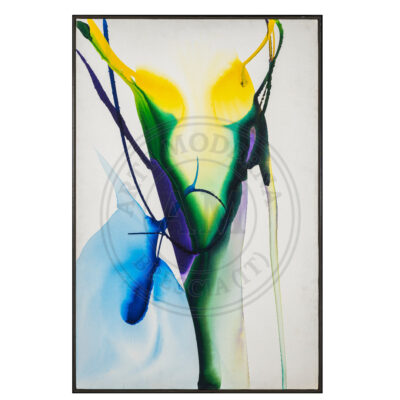


Phenomena Shield and Green
Technique
Acrylic on canvas
Dimensions
inch 39,4 x 23,6
Year
1969
Origin
Private collection, Chicago;
A.M. Arte Moderna, Brescia.
The work Phenomena Shield and Green (1969), acrylic on canvas, cm 100×60, belongs to a central and fully mature phase of Paul Jenkins’s research, one of the protagonists of American abstraction in the second half of the twentieth century, this canvas emblemati¬cally synthesizes the artist’s poetics, founded on a fluid, luminous, and strongly evocative painting.
Paul Jenkins (1923–2012) was a prominent figure in the international landscape of contemporary art, associated with Abstract Expressionism and in particular with the Color Field Painting movement, his career developed between the United States and Europe, particularly in Paris, where he came into contact with artists and intellectuals who contributed to strengthening the philosophical and spiritual dimension of his painting, unlike other exponents of action painting, Jenkins did not conceive the gesture as an impulsive or dramatic expression, but as the controlled revelation of a visual phenomenon.
The title Phenomena Shield and Green belongs to the series of the “Phenomena,” a designation that Jenkins systematically adopted starting in the 1960s, the term “Phenomena” refers to phenomenological philosophy, in particular to the idea of perception as direct experience and revelation of reality through light and color.
The word “Shield” suggests an element of protection or concentrated energy, while “Green” recalls a specific chromatic dominance of the work, green, in fact, is the structuring color of the composition: a fluid column that vertically traverses the canvas, modulated in shades ranging from emerald green to turquoise and luminous yellow, the “shield” could be interpreted as the central area irradiated with light, a sort of protective nucleus or energetic field that expands outward.
From a technical point of view, Jenkins used acrylic on unprimed or lightly treated canvas, acrylic, compared to oil, allows for faster drying and intense brilliance, characteristics that Jenkins exploits to obtain transparencies, overlays, and luminous glazes, thus taking advantage of the fluidity of the color, his technique was highly personal: he did not paint with a brush in a traditional manner but poured the color directly onto the inclined surface of the canvas, guiding it through controlled movements and sometimes with the aid of a spatula or unconventional tools.
In this work from 1969 one clearly perceives the tension between control and chance: the flow of color generates organic and unpredictable forms, but the vertical composition and the distribution of the chromatic masses reveal a precise intentionality, the light background amplifies the vibration of the saturated colors, the solar yellow in the upper part, the central green, the lateral incursions of blue and violet create a dynamic balance between light and depth.
bibliography:
Otto G. Ocvirk, Art Fundamentals: Theory and Practice, 3rd Edition, W. C. Brown Co., Dubuque, Iowa, 1975, pp. 96, illus. plate 56
Information request
Artwork:
Artist: